
In any software development cycle, the backend part is responsible for data management, application logic, and security. It is essential to be well-designed and scalable for any web or mobile application development process.
Now, business owners and project managers have a wide range of options for developing any web or mobile application. Hence it is very important to select the right tech stack based on the company goals and objectives. In this blog, we shall explore the top backend frameworks worth considering for 2023.
What are backend technologies?
A backend or server-side framework is a collection of gadgets and modules that aid in developing a website design. It influences the presentation of a web application and can impact your tasks.
It encompasses the function of various web applications that entails creating and maintaining the code that keeps a website running smoothly.
The backend framework is primarily based on coordinating languages such as Ruby, JavaScript, and Node.js, or accumulated languages such as Java, C#, and so on. The best backend framework makes it easier for developers to get started by reducing the need to create and configure everything from the beginning.
Backend developers are programmers who design, fix, and transform software application features that the end-user has never experienced before. When a user makes a request to the system via the front-end framework, the back-end developers must ensure that the program can respond to any request.
In this blog, we have discussed the top backend frameworks for software developers to learn in 2023. If you are a programmer or a software developer looking for the best backend frameworks, this article would help you to get a clear idea of the top backend frameworks.
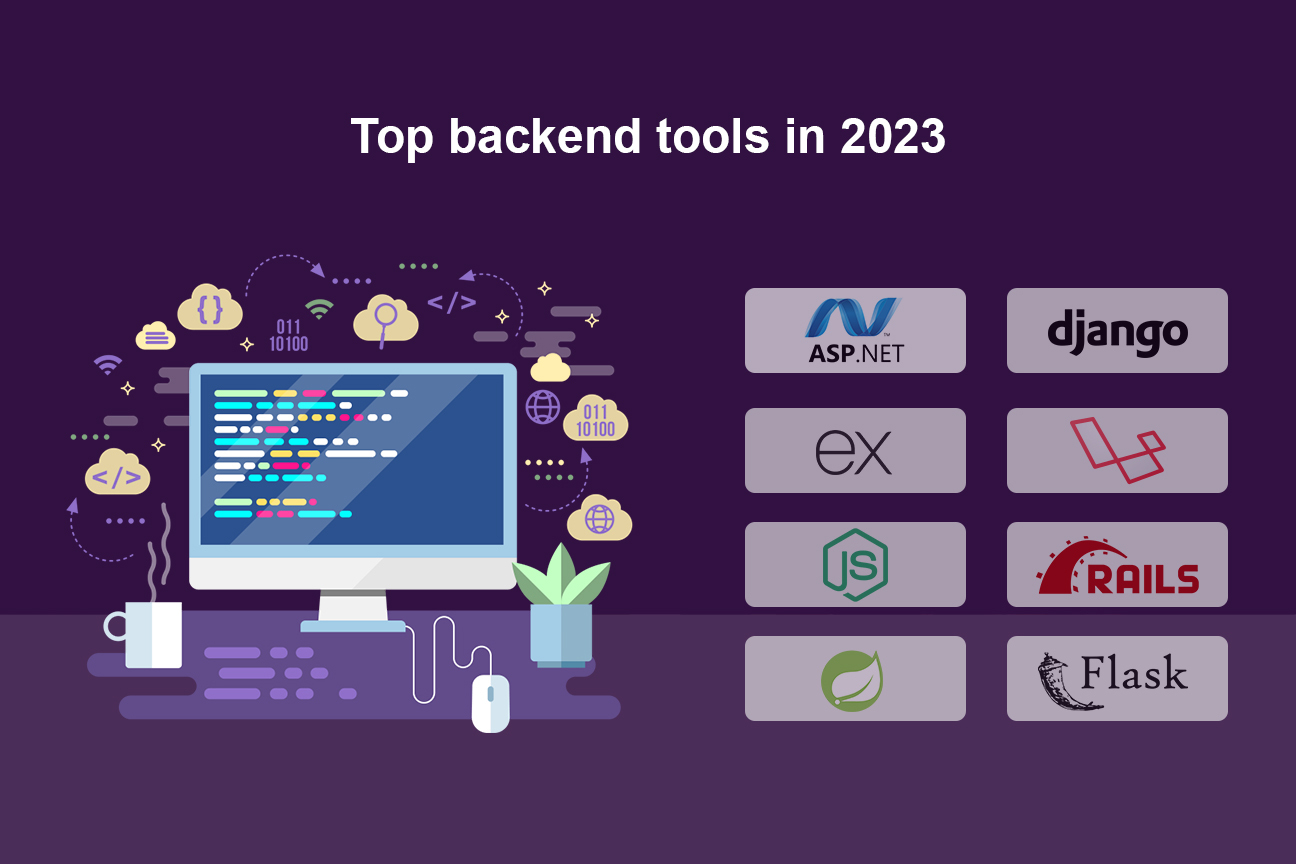
Top backend tools in 2023
1. Node.js
Node.js is a cross-platform runtime environment that is built on V8, an open-source JavaScript engine that is extremely fast in multi-user real-time data processing scenarios showing popularity in both client- and server-side development.- It uses a single-threaded event loop to run JavaScript, which reduces the execution time of individual applications.
- It is beneficial for shortening the time-to-market cycle and it is perfect for data-intensive applications since it uses an asynchronous, event-driven model.
- NodeJs reduces the loading time for an audio or video file because there is better code synchronization between the client and server for having the same code base.
- Netflix, GoDaddy, Microsoft, and Mozilla are a few companies that use Node.js
2. Ruby on Rails
ROR is a simple programming language, which can simplify the changes in codes for developers. The language is extremely portable, allowing it to run on almost any operating system.- It can work well for dynamic websites and also helps in the development of eCommerce websites like Shopify.
- Developers working on the Ruby platform can build high-quality web applications, which boast clean architecture and implement all CSS, HTML, and JavaScript files.
- ROR developers can add objects to any existing class without affecting stability which facilitates developers in creating flexible APIs.
- GitHub, Bloomberg, Zendesk, and Fiverr are a few companies that use ROR.
3. Django
Django is a free, python-based, open-source web development framework that facilitates clean and rational designing of websites driven by databases.- Pinterest, Dropbox, Instagram, and Spotify are some of the best Django apps.
- The framework protects against common security threats such as XSS and CSRF (Cross-Site Request Forgery) attacks, SQL injections, Clickjacking, and so on. Its user authentication system is also reliable for managing usernames and passwords.
- It gives you everything by default and hence reduces a lot of development time i.e. it automatically comes with an admin interface.
- It includes a module called the Django SEO framework that allows developers to reduce page load time by using cached templates and compressing CSS and JavaScript.
4. Laravel
Laravel is a cross-platform PHP framework that helps streamline the development of web applications using the model-view-controller (MVC) architectural pattern. PHP, is one of the first server-side web scripting languages, and Laravel is built on top of it. PHP continues to exist due to legacy code therefore it is used in most website development.- User authentication, API routing, HTML templating, database access, and security are some of the features offered by Laravel.
- Laravel is a progressive framework where you can build up to a fully scalable data-driven application using the same tools.
- Sail, a Docker-based installation that you can customize, makes it simple to install Laravel.
- BBC, Toyota Hallmark, and Huawei are a few of the companies that use Laravel to build their web applications.
5. Express.js
Express.js provides small, robust tooling for HTTP servers, which makes it an excellent choice for single-page applications, websites, hybrids, or public HTTP APIs. It allows you to quickly create a perfect framework with 14+ template engines.- It can be used to create a single-page, multi-page, or hybrid web application. It is a layer built on top of Node js that aids in the management of servers and routes.
- Express.js includes a debugging mechanism that can quickly locate bugs within the application, reducing debugging time.
- RESTful API URLs, or routes, are defined and connected directly to JavaScript functions to respond quickly to user requests.
- PayPal, Uber, and IBM use Express.js for web development.
6. Spring Boot
The Spring Framework (Spring) is an open-source application framework that provides infrastructure support for Java developers. It is one of the most popular Java Enterprise Edition (Java EE) frameworks and assists developers in creating high-performance applications using simple Java objects.- It has well designed MVC framework which provides a great alternative solution to a legacy web framework.
- Spring framework provides a lightweight container therefore this can be activated without the use of the web server or application server.
- It supports both XML configuration and Java-based annotations. As a result, it gives you the option of using any of them to build your enterprise application.
- Groupon, Intuit, Walmart, HubSpot, Zillow, and Dell are a few examples of the many companies that have used Spring Boot to build their web applications and microservices.
7. Flask
Flask is a simple, lightweight, and modular Python web framework that allows developers to use third-party tools and libraries only when they are required. Flask keeps a web application core simple and extensible- Flask is a micro framework that offers extensions for form validation, object-relational mappers, open authentication systems, uploading mechanism, and several other tools.
- Flask is a good choice if you want a lightweight codebase and is suitable for a simple application.
- Flask is a good choice if you want a lightweight codebase and is suitable for a simple application.
- It is highly compatible with the latest technologies with lots of resources available online especially on GitHub.
- LinkedIn, Twilio, Reddit, Dropbox, and Pinterest are a few companies that use Flask.
8.ASP.NET
Microsoft ASP.NET is a web application framework that allows programmers to create dynamic websites with easy cross-platform migration, configuration, and deployment services.- It performs faster than any popular web framework that allows using a full-featured programming language such as C# or VB.NET to build web applications easily.
- This tool can significantly reduce coding time, especially when developing large applications. There are various types of code reviews that assist in improving code quality hence there may be no way to write imperfect code.
- The framework comes with an incredibly rich toolbox through its Visual Studio integrated development environment which has continuous and constant monitoring features.
- Starbucks, Volvo, HP, and Siemens are a few examples of the many companies that have used ASP.NET to build their web applications.
Every developer and project manager expects their framework to provide high performance, ease of development, and flexibility. However, depending on the requirements of each application, the choice could easily favor one option over the others.